

Building a strong and steady lower body helps you stay independent as you age.
After 60, it’s essential to rev up your workout game to preserve muscle, bone density, and overall quality of life. One way to start is by adding squats to your routine, because they are stellar for building leg strength, improving daily movement, and boosting joint health. Squats focus on your calves, core, glutes, quadriceps, and hamstrings, all of which are necessary for standing, walking, staying balanced, and climbing steps. Once you get started, you can challenge yourself. According to Dr. Andrew Gorecki, PT, DPT, FAFS, Owner of Superior Physical Therapy in Traverse City, MI, and co-founder/CEO of MovementRx, a remote therapeutic monitoring platform used by PT clinics nationwide, your leg strength is considered top-tier if you can do this many squats after 60.
Is Squat Count a Reliable Measure?

Squat count is an excellent measure of functional lower-body capacity in those 60+. However, it doesn’t measure “pure strength,” Dr. Gorecki says. It tests a combination of endurance, coordination, balance, strength, cardiovascular capacity, and ankle and hip mobility.
“That’s actually why the test is useful. It captures the whole system that keeps someone functional in daily life, which is more important than any single metric,” Dr. Gorecki points out. “The reason clinicians use tests like the 30-second chair stand isn’t that squat count perfectly measures strength. It’s that when someone’s number drops significantly, it means something in that whole system is failing, and it correlates strongly with fall risk, hospitalization risk, and loss of independence.”
Essentially, if you’re able to perform a lot of squats with solid form, you have functional lower-body strength that translates to real-life movement.
“If you can’t do many, the reason might be strength, mobility, balance, cardiovascular capacity, or knee pain from bad form. Sorting out which one it is matters for how to fix it,” Dr. Gorecki adds.
Why Are Squats a Valuable Assessment of Aging Function?
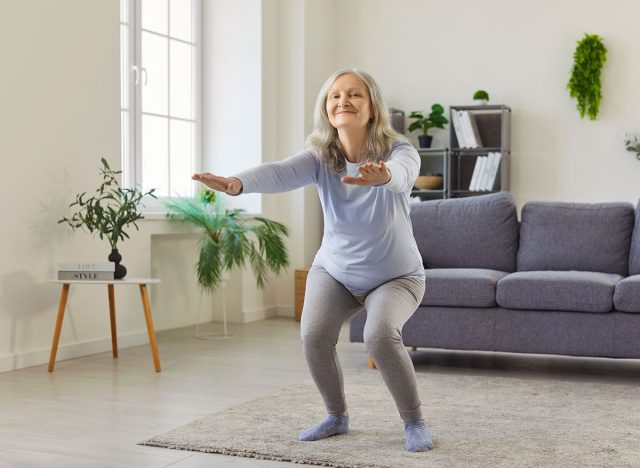
The squat pattern is embedded in basically everything older adults need in order to move seamlessly and remain independent.
“Getting off the toilet is a squat. Getting out of a chair is a squat. Getting out of a car is a squat. Picking up something off the floor is a squat plus a hinge. If any part of the squat pattern breaks down (ankle mobility, knee control, hip strength, core stability), all of those daily movements get harder,” Dr. Gorecki explains.
Squats also load the whole lower-body chain at the same time—the glutes, quads, hamstrings, core, hips, knees, calves, spine, and ankles. Testing the squat pattern serves as a solid functional test of the entire system.
“That’s why it’s so predictive of outcomes clinicians care about like fall risk and independence, and why it’s more useful than isolated strength tests like a leg extension max,” Dr. Gorecki notes.
What Squat Number Counts as Top-Tier After 60?
While there isn’t a universal squat benchmark for individuals over 60, we do have some numbers to work with.
According to Dr. Gorecki, “The 30-second chair stand test, developed by Rikli and Jones as part of the Senior Fitness Test battery, has actual normative data across age groups. That’s the closest thing to a legitimate benchmark.”
Here’s what to strive for, inspired by those norms as an anchor. In the 30-second chair stand test, the following serves as the “top range”:
- Ages 60-64: 16 or more for men; 14 or more for women
- Ages 65-69: 15 or more for men; 13 or more for women
- Ages 70-74: 14 or more for men; 12 or more for women
- Ages 75-79: 13 or more for men; 11 or more for women
- Ages 80-84: 11 or more for men; 10 or more for women
- Ages 85-89: 10 or more for men; 8 or more for women
Elite After 60?
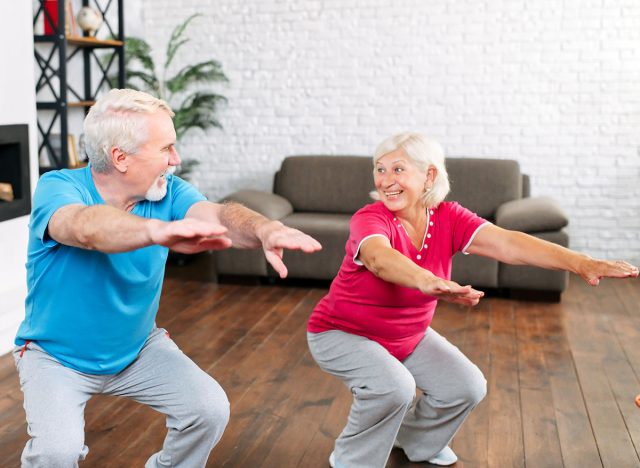
“If someone can do 20 or more chair stands in 30 seconds at any age over 60, that’s elite. That number is roughly what fit adults in their 40s produce,” Dr. Gorecki explains. “If we’re talking about deep bodyweight squats (down to thighs parallel to floor, back up, no assistance), the counts are lower because the range of motion is bigger. A rough estimate for top-tier bodyweight squats in 60 seconds would be 25 to 30 for men, 20 to 25 for women. But I want to be honest, that’s an extrapolation, not a validated number.”
The goal shouldn’t be chasing a certain squat number. What matters more is whether the squat pattern is effective. For instance, if you’re able to get up from a seated position without pushing off with your hands, do 10 to 15 consecutively, and still feel stable, your lower body is working just fine.
“If you can’t, that’s not just a fitness problem. That’s an independence issue you want to address before it gets worse,” Dr. Gorecki adds.