
A few good strength reps in the morning can set a pretty useful tone for the day. After 65, the bigger goal is giving your muscles regular resistance so they have a reason to stay strong. Morning training works well here because it can be short, focused, and easy to repeat before the rest of the day gets busy.
When I coach men in this age group, I usually look for movements they can do well week to week. I want enough resistance to challenge the muscles without making every session feel like a test. That approach gives us room to build strength while still recovering well between harder days.
This routine keeps that idea simple. You’ll move between lower- and upper-body exercises so no single area gets hammered all at once, then finish with a short plank hold. Use the easier versions when you need them and make the movements harder only when the current setup stops feeling challenging.
RELATED: 4 Wall Exercises That Rebuild Thigh Power Faster Than Lifting Weights After 65
Alternating Reverse Lunge
Reverse lunges put more responsibility on one leg at a time, which makes them useful for keeping both sides strong. Stepping backward also gives you a little more room to control the movement before you return to standing. If balance gets in the way, hold onto a counter so the legs can still do the work.
Muscles Trained: Quads, glutes, hamstrings, calves.
How to Do It
- Stand tall with your feet about hip-width apart.
- Step your right foot backward.
- Bend both knees into a comfortable lunge.
- Press through your front foot to stand.
- Switch sides.
- Continue alternating for the full set.
Recommended Sets and Reps: Perform 2 to 3 sets of 6 to 10 reps per side. Rest for 45 to 60 seconds.
Best Variations: Supported reverse lunge, shorter-range reverse lunge, split squat.
Form Tip: Let your front leg bring you back to standing.
Box Squat
A box gives you the same target on every squat, which makes it easier to judge whether your strength is improving. Your thighs and glutes must control the descent, then produce enough force to stand back up. Once bodyweight reps feel easy, hold a dumbbell to keep the exercise useful.
Muscles Trained: Quads, glutes, hamstrings, core.
How to Do It
- Stand in front of a sturdy chair or box.
- Set your feet about shoulder-width apart.
- Reach your arms forward.
- Sit your hips back and bend your knees.
- Lower until you lightly touch the box.
- Press through your feet to stand.
Recommended Sets and Reps: Perform 2 to 3 sets of 8 to 12 reps. Rest for 45 to 60 seconds.
Best Variations: Higher box squat, goblet box squat, slow-tempo box squat.
Form Tip: Touch the box lightly without relaxing onto it.
RELATED: 4 Bed Exercises That Flatten Midsection Thickening Faster Than Crunches After 60
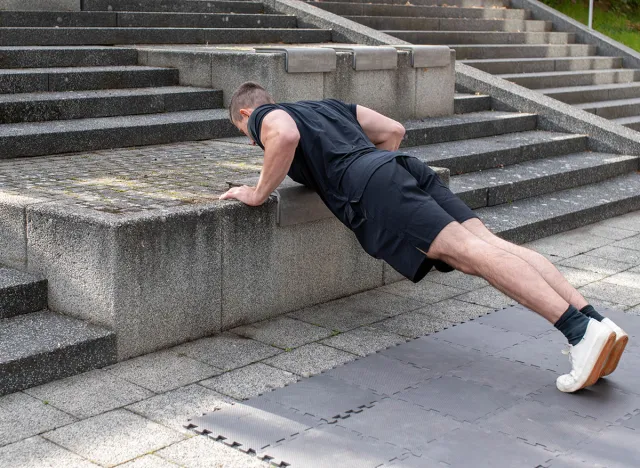
Incline Push-Up
Incline push-ups are easy to scale for pressing strength. The higher surface reduces how much body weight you have to move, which lets you build clean reps without forcing a floor push-up before you’re ready. Lower the surface gradually as your chest and arms get stronger.
Muscles Trained: Chest, shoulders, triceps, abs.
How to Do It
- Place your hands slightly wider than shoulder-width on a sturdy counter or bench.
- Step your feet backward.
- Brace your abs.
- Bend your elbows and lower your chest toward the surface.
- Stop when your elbows reach about 90 degrees.
- Press through your hands to return to the top.
Recommended Sets and Reps: Perform 2 to 3 sets of 8 to 12 reps. Rest for 30 to 45 seconds.
Best Variations: Wall push-up, lower incline push-up, slow-tempo incline push-up.
Form Tip: Keep your body in one straight line throughout the rep.
Band Pull-Apart
Band pull-aparts give the muscles across your upper back some direct attention. That’s useful when much of your day keeps the arms in front of you, and your training includes more pressing than pulling. Choose a band that lets you open the arms fully without having to lean backward or shrug.
Muscles Trained: Upper back, rear shoulders, rotator cuff.
How to Do It
- Stand tall and hold a resistance band in front of you.
- Keep your hands around shoulder-width apart.
- Raise your arms to about chest height.
- Pull your hands apart.
- Open the arms until the band reaches your chest.
- Return slowly and repeat.
Recommended Sets and Reps: Perform 2 to 3 sets of 10 to 15 reps. Rest for 30 seconds.
Best Variations: Lighter-band pull-apart, wider-grip pull-apart, paused pull-apart.
Form Tip: Pull the band apart without shrugging your shoulders.
RELATED: 6 Popular Snacks Consumer Reports Flagged for Lead and Cadmium
Plank Hold
Finish with a simple test of how well your midsection can stay braced under your own body weight. A plank asks the abs to hold your trunk in position while the shoulders support you above the floor. Stop the set while you can still hold that position cleanly instead of stretching the clock.
Muscles Trained: Abs, shoulders, glutes.
How to Do It
- Place your forearms on the floor.
- Extend your legs behind you.
- Position your elbows beneath your shoulders.
- Brace your abs.
- Keep your body straight from your head through your heels.
- Hold while breathing normally.
Recommended Sets and Reps: Perform 2 to 3 holds of 20 to 40 seconds. Rest for 30 to 45 seconds.
Best Variations: Kneeling plank, incline plank, longer plank hold.
Form Tip: Stop the set once you can no longer keep your hips level.
RELATED: 5 Standing Exercises That Improve Balance Better Than Tai Chi After 65
Keep Your Morning Strength Work Moving Forward
Morning strength work doesn’t have to look identical every day. Use this routine a few times per week, keep easier sessions truly easy, and push the resistance a little more when you’re recovered.
- Add difficulty gradually: More reps, lower inclines, or extra resistance can keep the exercises progressing.
- Use support when it helps: A counter can keep balance from limiting your leg work.
- Keep some heavier training in the week: Dumbbells and stronger bands give your muscles room to keep adapting.
- Eat enough protein: Adequate protein supports the muscle you’re working to maintain.
- Watch your recovery: Back off when soreness or fatigue carries into the next session.
- Track your strength: Cleaner reps and harder variations tell you more than simply finishing the routine.
References
- Brogno, Brian. “Aging With Strength: Functional Training to Support Independence and Quality of Life.” Inquiry : a journal of medical care organization, provision and financing vol. 62 (2025): 469580251348133. doi:10.1177/00469580251348133
- Burtscher, Johannes et al. “How much resistance exercise is beneficial for healthy aging and longevity?” Journal of Sport and Health Science vol. 12,3 (2023): 284-286. doi:10.1016/j.jshs.2022.11.004
The post 5 Morning Exercises Men Over 65 Need to Stay Strong appeared first on Eat This Not That.