
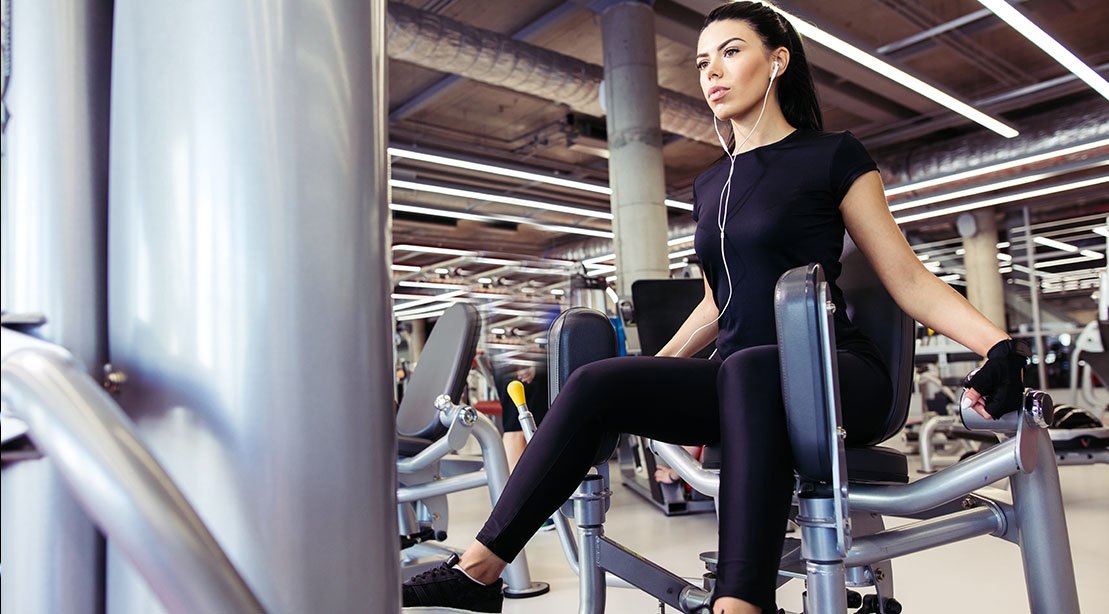
The hip adduction machine, otherwise known as the yes/no machine, has a reputation problem.
First strike, it’s a machine.
Second strike, isn’t it just a rehab exercise?
Third strike, where should I look as I open and close my legs?
Three strikes and you’re out. But wait, not so fast.
To many lifters, it’s just seen as a fluff exercise to tone the inner thighs. Compared with pulling a heavy deadlift or grinding through a deep squat, it is easy to see why this machine gets zero respect.
But calling the adductors your “inner-thigh muscles” undersells them. The adductor magnus deserves special mention because it helps with hip extension.
So, let’s not drop it in the batting order just yet.
This machine gives you a simple way to directly load a large and often neglected muscle group without adding another set of lateral lunges. Despite its reputation, is it worth adding to your lower-body program?
Let’s take a closer look at this much-maligned machine with the help of a few expert coaches.
Why the Adductor Machine Catches Flak
In a gym culture that equates hardness with effectiveness, this machine is easy to overlook. You sit down, bring your legs together, and repeat. There is no balance challenge, no barbell on the floor, and no obvious athletic movement.
It also gets hit with the same “non-functional” criticism as the hip abductor machine. Critics argue that sitting in a fixed position and squeezing your thighs together does not look like anything performed in our actual lives. Then there is the compound-lift argument. Squats, deadlifts, and their wide-stance variations already train the adductors. So direct hip adduction work is redundant.
Let’s not forget about its reputation.
For years, it’s been treated as an “inner-thigh toning” machine rather than a strength tool. “The hip adductors are a huge muscle mass,” explains physical therapist Dan Swinscoe. “So, training them is good for you.” Once you understand how large and functionally important the adductors are, it becomes much harder to argue that directly training them is pointless.
Why You Don’t Need It
Here are more reasons you don’t need it.
Doubling Up
Squats, deadlifts, lunges, and other big lower-body lifts already train the adductors, especially the adductor magnus. You could argue that direct hip adduction work adds more on top of what you’re already doing.
It’s Not Functional
You are seated, the range of motion is fixed, and the machine stabilizes you. “It was built in the ‘70s for bodybuilding,” says Swinscoe. “If bodybuilding is your goal, it works fine.” But it doesn’t challenge balance, trunk control, or force transfer the way cutting, running, lunging, or single-leg work does.
It Only Trains One Function
The adductors do more than adduct. “Stronger muscle isolation is still a stronger muscle,” explains physical therapist Justin Farnsworth. “But the adductors do more to stabilize the hip than to squeeze your knees together.”
Depending on the muscle and hip position, they assist with hip extension, flexion, rotation, and control of the pelvis and femur. The machine isolates adduction in a stable seated position, so it doesn’t train the full range of what these muscles can do.
That limitation is real.
What the Research Says About the Adductors
The research makes one thing clear: the adductors are not just “inner-thigh muscles.” In a 2025 study, researchers found that the muscle’s estimated torque-producing capacity for hip extension was more than twice that for adduction. This suggests the adductor magnus plays a much larger role in lower-body strength than the “inner-thigh” label implies.
The broader strengthening research also gives direct adductor work a legitimate case. In male soccer players, an adductor-strengthening program built around the Copenhagen side plank reduced the risk of reported groin problems by 41% over a season.
That doesn’t prove the hip adduction machine itself prevents groin injuries, but it does show that improving adductor strength matters. Think of it like other isolation exercises: We know chin-ups train the biceps harder than most curl variations, but that doesn’t make curls useless for developing biceps size and strength.
Think of the adductor machine in the same way.
What Are the Main Benefits of the Hip Adduction Machine?
Lifters trash it, but that doesn’t mean the adductor machine doesn’t have benefits. It does, and here they are.
Direct Work
Like many machines with a fixed range of motion, adductor machines focus on one muscle target: the inner thigh muscles. “It’s hard to sell the average gym-goer on the value of hip adduction strength,” explains strength coach Gareth Sapstead. “For these people, the hip adduction machine does have some value because it’s easy to set up and has few things that can go wrong.”
It Adds Lower-Body Volume
Compound lifts are great, but they come with a recovery cost. This machine gives you a simple way to add volume without eating into your recovery. For lifters who want more thigh development without turning all of leg day into a battle, that’s a win.
It Can Complement Groin-Strengthening Work
Research on groin resilience doesn’t prove the machine itself prevents injuries, but it does support the value of stronger adductors. That makes the machine a useful piece of a broader plan that might also include Copenhagen planks, Cossack squats, or the lateral step-up demonstrated by Swinscoe above.
It Is Easy to Progress
This is one of the machine’s most underrated strengths. It makes progressive overload simple, and simplicity is often what you want when the goal is more muscle and strength.
Is It For You?
If you’ve thrown away all preconceived notions of the adductor machine, let’s get down to who it’s for and who should skip it.
Who It’s For
- Bodybuilders and physique-focused lifters seeking enhanced thigh development and direct adductor work.
- Athletes who want to increase adductor strength as part of a broader lower-body program that also includes sprinting and single-leg work.
- Lifters who want extra lower-body volume without more fatigue.
Who Should Skip It
- Anyone with acute groin pain or a current adductor strain.
- Lifters who experience sharp pain, pinching, or discomfort during the movement.
- Those who force excessive range of motion and turn it into a battle of you versus the machine
- Athletes who use it as a substitute for real-world adductor demands. “If you’re seeking more effective exercises to improve structural balance around the hips,” explains Sapstead. “Copenhagen hip adduction exercise would do a better job.”
Risk Vs Reward
The hip adduction machine falls into the low-to-moderate risk, moderate reward category. It’s stable, easy to control, and simple to load, which removes a lot of the technical risk you get with compound lifts. But that doesn’t mean you can pile on weight and force your legs apart as far as possible. The biggest risks come from too much load, too much range, and too much volume before the groin is ready for it.
The reward is straightforward. You get direct adductor loading without much systemic fatigue. That makes the machine useful for hypertrophy and for adding more lower-body work without another squat, deadlift, or lunge variation.
The main limitation is transfer. The machine strengthens hip adduction, but it doesn’t replace how the adductors work in the real world. Those tasks demand more from the pelvis, trunk, and entire lower body. That does not make the machine less valuable. It just means the strength you build there still needs to live alongside more complete movement training.
The verdict is simple: if you want stronger adductors without doing another set of Copenhagen Side planks, the reward outweighs the risk. Just do not mistake it for a complete lower-body solution.
How to Program the Hip Adduction Machine for Leg Growth
The hip adduction machine works best as an accessory exercise. Put it after your main squats, deadlifts, lunges, or split squats.
Sets & Reps: 2 to 4 sets of 12 to 25 reps. The higher the reps, the fewer sets.
Frequency: 1-2 times per week.
Rest: 90 seconds between sets.
Progression is straightforward: add reps and then add load. When you can hit all reps with good form, increase the weight, reduce the reps, and then build it back up.
The Final Squeeze
The hip adduction machine isn’t useless; it’s a simple accessory that gives you a direct way to train a large muscle group that shows up in many lower-body movements. Are there more “functional’ adductor exercises? Sure, but that doesn’t mean you should discount this machine from your rotation.
The machine does what it does well: isolate one part of that job with very little technical or recovery cost. When used in conjunction with Copenhagen, Cossack squat, and Lateral lunge variations, it can help build stronger adductors without adding another compound lift.
The hip adduction machine gets dumped on because it’s not cool, functional, or very athletic. But if your goal is stronger adductors, better thigh development, or a low-fatigue way to add direct groin work, this machine earns its place.
Just remember not to make eye contact with anyone, OK?