
When someone comes to me with an injury (or one of those nagging aches that’s been hanging around for weeks and they can’t figure out why) I run the same diagnostic almost every time.
It’s simple. You can run it on yourself. And it’ll teach you what to look for to dodge future issues.
The 3-part diagnostic
I’m looking for a recent spike in any of these three:
- Volume – how much of the thing you’re doing
- Intensity – how hard the thing is
- Novelty – how new the thing is to your body
A big jump in any ONE of these increases your injury risk. A jump in two or three at once? Bingo.
Here are some examples:
- You fall in love with a new hobby, like rock climbing (novelty), and spend hours at the climbing gym your first week (volume), but pick up a nagging wrist injury you can’t seem to shake.
- You decide to sign up for a half-marathon race with your friend. A few weeks out, you jump right into the later stages of a training program to catch up (volume & intensity), but get shin splints and can’t complete the race.
- You start a new strength training program and decide to max out on each lift to really test yourself (novelty, intensity), but partway through your shoulder does something funky and now it aches when you try to sleep on your side.
Running the diagnostic in real life
I’ve been coaching Steve (founder and Rebel Leader of Nerd Fitness) for the last couple of months, and recently his back started getting tight after a round of golf.
When we ran the diagnostic, things became clearer:
- His step count jumped from around 6,500 on a normal day to 17-20k on golf days (volume spike)
- He went from sitting at a desk straight into cranking full-power swings (intensity spike)
- Golf also asks the body for rotational power it doesn’t get much of day-to-day (novelty spike)
His back was responding as we might expect when we turn the dial up on all three variables at once.
|
|
Here’s how we use that information to build a plan.
✅ Raise his baseline daily walking week over week so 15k+ steps isn’t a shock to the system
✅ Build in a real warm-up before he tees off to prep his body properly
✅ Create a bigger buffer of strength, mobility, and stability in the areas golf demands most (rotation, hip mobility, etc.)
The bigger idea: graded exposure
This diagnostic works because it points at the same principle running underneath almost everything we do in coaching: graded exposure (AKA Progressive Overload).
Strength training? The goal is to challenge your body just the right amount. Too little, nothing happens. Too much, you put yourself at risk. It’s the Goldilocks zone we’re after. 👧🐻🐻🐻
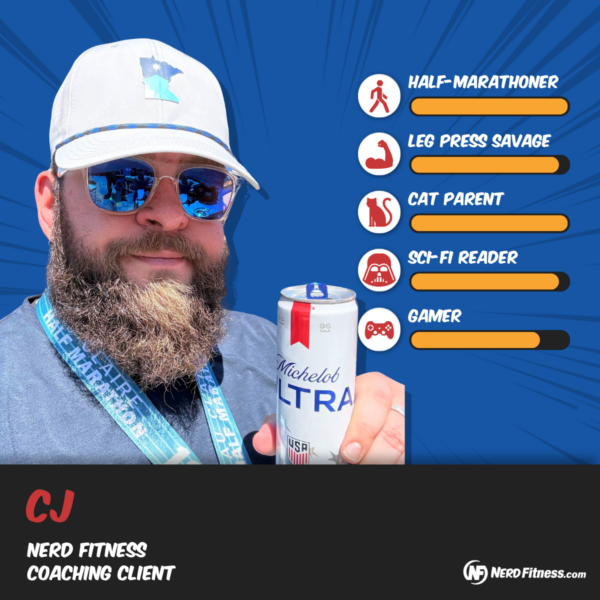
Training for an event? Give yourself plenty of time to build up for it so you never have to spike up your intensity or volume at the same time. My client CJ just finished a half marathon and felt amazing the whole way – but only because we spent 16 weeks of consistent, gradual training getting him ready. He’d previously dealt with shin splints and other issues. This time? Injury-free. Here’s what he messaged me after the race:
Rolling out of bed and running a 10k with some left in the tank by the end was a distant dream a year ago! It was the perfect day and a fantastic race environment. I know I put the work in, but I couldn’t have done this without your plan and guidance, so I cannot thank you enough! So, what’s next coach? 😁
Recovering from an injury or chronic ache? First, make sure you get checked out by your doc. Good physical therapy is basically graded exposure with extra steps. You’re slowly rebuilding capacity and tolerance in the area, teaching your body it can handle load again.
Heck, this even applies to habit change. Too much change at once? Hard to sustain, easy to burn out. Too little change? Progress is so slow it’s hard to evaluate what’s working. We want just enough challenge to move the needle.
Same principle. Different applications.
Run the diagnostic on yourself
Whether you’re feeling something nagging right now, OR you’re about to start something new (a class, a sport, a season, a project) – ask yourself:
- Am I (or did I recently) make a giant jump in volume? (Amount of the thing)
- Am I (or did I recently) make a sudden leap in intensity? (How hard the thing is)
- Am I doing something completely new? (First Zumba class, first hike of the season, first pickup basketball game in 5 years)
If you said yes to one -> ease in. If you said yes to two or three -> really ease in.
This doesn’t mean you can’t do hard things. It means giving your body a fair chance to keep up with what you’re asking of it.
Level up one step at a time. That’s how you stay in the game for the long haul. 💪
-Matt