
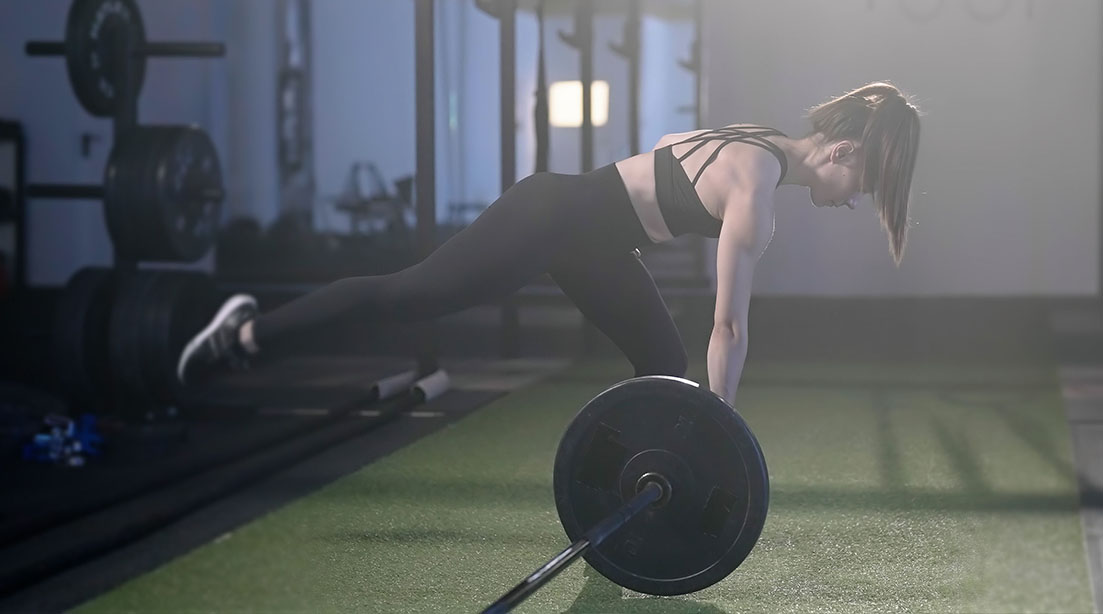
Unilateral exercises like the single-leg Romanian Deadlift—aka the RDL— reduce muscle imbalances, strengthen stabilizer muscles, and enhance muscle development. But there are some drawbacks to these types of moves—the biggest possibly being the inevitable wobbles. Once you go heavy, fighting to stay upright oftentimes become a bigger challenge than building muscle.
The fix, however, is simple: By holding a secure anchor, you’ll take the awkwardness out the exercise. Adding stability will drive more action to the working muscle.
That’s the thinking behind the assisted single-leg RDL. By holding onto a rack or wall for light support, you remove balance as the limiting factor—it’s also not considered cheating—and shift the focus back where it belongs: your glutes and hamstrings. It transforms what was once a circus trick into a strength movement that exposes asymmetries and builds posterior-chain durability from the ground up.
If you want stronger hamstrings, cleaner deadlifts, and fewer “why does that side feel weird?” moments, this move deserves a spot in your workout rotation.
What Is the Assisted Single-Leg RDL?
The assisted single-leg RDL is a unilateral hip hinge performed with light external support for stability. It’s performed with a dumbbell or kettlebell held in the opposite hand to the working leg (a contralateral load), which increases hip stability and core engagement. Unlike the traditional variation, which often becomes a balancing act, the assisted version eliminates the wobble, allowing you to focus on loading your hips and hamstrings.
By holding onto a rack, wall, or dowel with your free hand, you gain enough stability to maintain a good position and consistent tension in the working hamstring. That means more quality reps, better muscle recruitment, and less wasted energy trying not to tip over.
How to Do the Assisted Single-Leg Romanian Deadlift Correctly
Setup:
- Stand side on to a squat rack or wall.
- Hold a dumbbell or kettlebell in the hand opposite your working leg.
- Place your free hand lightly on the rack or wall.
- Keep a soft bend in the working knee and brace your core.
Execution:
- Shift your weight into the working foot and root it to the floor.
- Hinge at the hips by pushing them straight back, feeling your hamstrings lengthening.
- Let your non-working leg extend behind you as a counterbalance.
- Keep your hips square and your spine neutral.
- Lower until you feel a strong stretch in your hamstring.
- Drive through your foot and squeeze your glute to return to the starting position.
Complete all reps on one side before switching.
Common Single-Leg RDL Mistakes (And Fixes)
Just because you’re holding on to something doesn’t mean all the form issues go away. Here’s what to look out for before it becomes an issue.
Hips rotating open
As you hinge, the non-working hip rotates open toward the ceiling, reducing hamstring tension and shifting weight onto the hip joint, rather than the muscle.
The Fix: Keep your hips square. Imagine your hip bones are headlights pointing straight at the floor. If one “headlight” points upward, reset and slow down. If it’s still an issue after this cue, reduce the range of motion to stop it from happening.
Rounding the Lower Back
Losing neutral spine shifts tension from the hamstrings and glutes to the lumbar spine.
The Fix: Maintain a long spine. Think “chest proud, ribs down.” Hinge from the hips and feel your hamstrings lengthen.
Excessive Knee Bend
Turning the hinge into a squat reduces the hamstring stretch and shifts the emphasis to the quads. It’s not terrible, but it’s not the point of this exercise.
The Fix: Keep a soft bend in the knee, then freeze it. Push the hips back, not down.
Using Too Much Upper-Body Support
Gripping and yanking off the rack makes the movement easier and reduces the tension on the working leg.
The Fix: Use only light fingertip contact. The hand is there for balance, not assistance. If you can’t do it without pulling, reduce the load.
Benefits of Single-Leg RDL Benefits
Unilateral training is often an afterthought because of the lighter load and the ego hit that comes with it. But this exercise fixes that and more.
Exposes & Reduces Strength Imbalances
Bilateral RDLs hide asymmetries. One hip shifts, one hamstring works harder, and you don’t notice until something hurts. The assisted single-leg RDL requires each side to pull its own weight. The result is better symmetry, cleaner mechanics, and stronger lower-body lifts across the board.
Trains The True Hip Hinge
Because balance isn’t the main challenge, you can focus on the hip hinge while keeping the spine neutral. That reinforces proper hinge mechanics that carry over to deadlifts and kettlebell swings.
Builds Hamstring Strength
The assisted single-leg RDL loads the hamstrings in a stretched position, a key factor in building strength and injury resilience. Strong hamstrings at long lengths strengthen your brakes, which are critical for injury prevention, especially during sprinting and change-of-direction work.
Hip Stability Development
Single-leg hinges challenge your ability to keep the pelvis level. They light up the glute medius and improve lateral hip stability, which is essential for knee health and enhanced lower-body performance.
Programming Suggestions
This exercise is best placed as an accessory exercise after your bigger bilateral movements, since you want to save your energy for heavier loads. The following are general recommendations, depending on your goal.
For Strength:
- 3–4 sets of 6–8 reps per leg
- Use a moderate-to-heavy dumbbell or kettlebell
- Focus on controlled eccentrics
- Rest 90 seconds between legs
For Muscle:
- 3 sets of 12 reps per leg
- Use a 3-second eccentric to increase time under tension
- Add a brief pause at the bottom to eliminate momentum
- Rest 2 minutes between sets.
Deadlift Accessory:
- 2–3 sets of 8–10 reps per leg
- Perform after bilateral RDLs, trap bar deadlifts, or conventional pulls with a moderate to heavy load
- Prioritize eccentric, pauses, and powerful lockout
- Rest 30 seconds between legs and 2 minutes after each set.