
Maintaining good posture as you age is much more important than aesthetics.
As you age, maintaining solid posture is essential for your overall health and well-being. By standing up tall, your body weight is properly centered over your feet. According to Harvard Health Publishing, this supports correct form during workouts, which could reduce your risk of injury and help you further progress toward your goals. Adding balance training to your routine can positively impact your performance in hobbies you love, like pickleball, golf, yoga, dancing, gardening, and more.
If you’re curious about how you can optimize your routine, we spoke with Jessi Heinsohn, PT, DPT, a Physical Therapist and Doctor of Physical Therapy with ATI Physical Therapy, who shares four at-home exercises that can help support better posture faster than back braces after 60.
“Relying on a back brace is similar to always using a calculator. It may get you the right answer, but you don’t know how to do it yourself,” explains Dr. Heinsohn. “A back brace, while in some cases useful or needed, often encourages our brain to turn off what little postural support our muscles are already providing. Our bodies are smart and try to conserve as much energy as possible when performing tasks, so if you give it a crutch, it will use it. Constant use of a back brace will further atrophy muscles and ultimately worsen your natural resting posture.”
Scapular Retractions
Scapular retractions fire up the muscles in the central thoracic region, which help support solid shoulder blade positioning and upper-trunk posture, explains Dr. Heinsohn.
- Begin standing tall.
- From there, think about moving your shoulder blades down toward your hips.
- Then, “pinch” them together slightly toward your spine.
- Hold this position for 10 seconds.
- Repeat for the prescribed reps.
“You may feel some tightness in your chest or even front of your neck, but you should also feel the muscles on your back between your shoulder blades working,” Dr. Heinsohn says, adding, “Pro tip: If your chest moves forward or your low back arches, you’ve gone too far!”
Seated Good Morning
“This exercise targets the posterior chain muscles which is a group of interconnected muscles running down the back of the body from the upper back and neck to the calves,” Dr. Heinsohn explains.
- Begin sitting tall at the edge of a sturdy chair or workout bench with your feet flat on the ground.
- Press your knees out slightly as you activate your glutes.
- Place your hands behind your head or cross them in front of your chest.
- Maintain a straight back and keep your shoulder blades in a retracted position.
- Hinge forward at the hips, leading with your chest and make sure to not round your back.
- Lower your torso until you feel a solid, deep hamstring stretch.
- Use your glutes and lower back to return to the start position.
“This exercise can be limited by hip mobility, so be sure to go as deep into the movement as is comfortable while maintaining proper technique. As you continue to use this exercise, you will notice improvements in range of motion and ease,” Dr. Heinsohn says, adding, “Pro-tip: Go slowly through this movement and add a slight hold at the bottom to really encourage engagement of all muscle groups.”
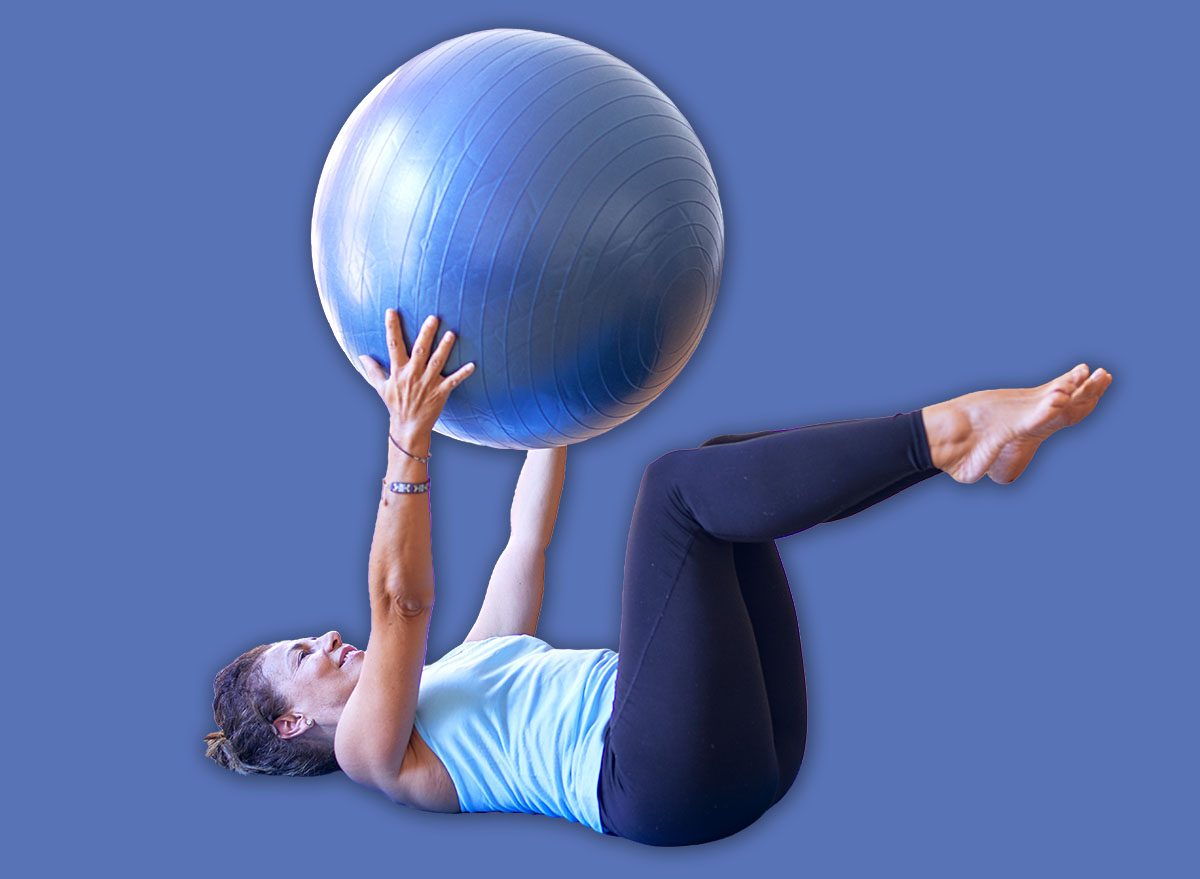
90/90 Dead Bug Isometric With Swiss Ball
This move strengthens the core by activating the deep transverse abdominis and supports spinal stability.
“This a great abdominal exercise for beginners and can be as easy or challenging as you’d like it to be,” Dr. Heinsohn explains.
- Begin lying flat on your back on a yoga mat with your knees bent and your feet flat.
- Position a Swiss ball on your stomach.
- Lift your arms toward the ceiling so that your hands touch the edge of the Swiss ball.
- Activate your abdominals while pressing your arms down into the ball toward your hips.
- At the same time, drive your knees into the ball.
- Hold for 10 to 30 seconds.
- Repeat for the prescribed reps.
According to Dr. Heinsohn, make sure you’re breathing throughout the hold. This supports strong abdominal muscle activation while preventing you from relying on abdominal pressure from holding your breath to stabilize your spine.
To make this exercise more challenging, lift your feet off the yoga mat and hold your knees up at a 90-degree angle. In addition, press harder into the ball.
Wall Angels
“This exercise targets your upper back, shoulders and scapular stabilizers. Additionally, it helps improve thoracic mobility, stretches the chest, and even corrects poor forward-head or slumping posture,” Dr. Heinsohn explains.
- Stand tall with your back pressed against a wall, your elbows bent to 90 degrees, and the backs of your hands against the wall.
- Slowly reach your arms overhead in a “snow angel” motion while pressing your arms into the wall.
- Keep your core engaged throughout, holding for 1 to 5 seconds.
- Lower your arms with control to return to the start position.
- Repeat for the prescribed reps.
If your current range of motion does not allow your head to touch the wall while your chin is tucked, feel free to place a small rolled towel between the head and the wall.
Alexa Mellardo