
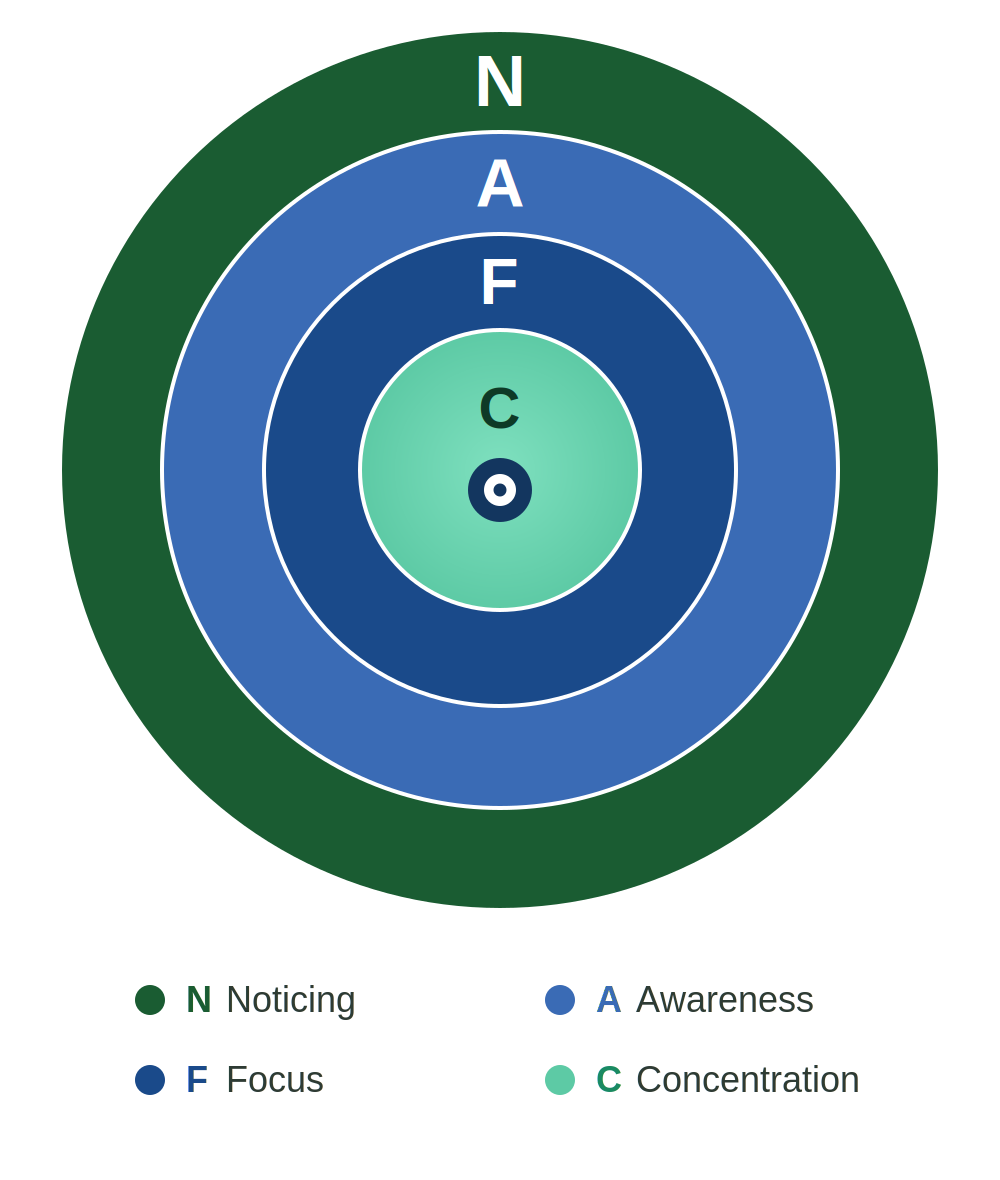
Most of the conversation around focus is obsessed with getting in. How to enter deep work. How to reach flow. And how to finally concentrate. We treat attention like a door we just need to push hard enough to open. But the spheres of attention tell a different story. Reaching the center is only half of it — and not the half that quietly costs you.
If you watch your own days closely, the more interesting half isn’t the way in. It’s the way out — the quiet, unannounced slide back toward the surface that happens while you’re convinced you’re still doing the work.
Going deep is slow. Coming out is instant.
Reaching the innermost layer of attention — real concentration, the kind where you look up and three hours have vanished — takes time. It takes intention and an environment built to support it. You don’t stumble into it on a busy Tuesday between meetings. You climb toward it, sphere by sphere, from noticing to awareness to focus and finally into that immersive center.
Leaving, though, costs almost nothing. A notification. A knock at the door. A single context switch. One interruption and you’re out — and here’s the part most people miss: you don’t gently step back one rung. You don’t drop from concentration neatly into focus. You usually tumble all the way back to awareness, or even out to noticing, and then you have to make the whole climb again.
That asymmetry is the whole game. We protect our calendars against starting late. We rarely protect them against falling out.
The danger is that the slide feels like working
If the slide were obvious, we’d catch it. The trouble is that the outer spheres are comfortable, and they impersonate progress beautifully.
Awareness is the worst offender. You open the project, you look at the task, you feel the low hum of engagement — and you mistake that hum for momentum. You’re not avoiding the work, exactly. You’re orbiting it. Checking on it. “I’m on it.” But orbiting isn’t committing, and the longer you hover there, the more it feels like you’ve done something when you haven’t moved at all.
Noticing does the same thing in a faster, glossier package. Scrolling is noticing with the illusion of productivity layered on top. Your attention is moving constantly, picking up signal after signal, and none of it deposits anywhere. Motion without progress. The tab is open, so surely something is happening.
It isn’t. And the reason this matters is that the world we live in actively rewards the shallow end. The doing, the checking, the going — that’s low-effort, high-visibility, and it feels productive because the boxes get ticked. The deeper spheres, where the breakthroughs and the ideas worth having actually live, ask more of us and show less for it in the moment. So we drift outward, do more, and only later look up and wonder where the real work went.
Catching yourself is a noticing skill
[Episode embed placed here — a natural mid-post break before this section. Transistor share link to be supplied.]
Here’s the strange, almost circular fix. The way you catch the slide is by noticing it.
You stop. You pause. And you ask the diagnostic question the spheres are really built for: where am I right now, and is that where I need to be? Not an essay. Not a journaling exercise. Just a beat of honest attention turned back on your own attention. Hold on — I drifted. I’m in awareness, but this task needs focus. How do I get back?
This is where structure earns its keep. The reason I run Focus Fix sessions inside TimeCrafting Trust isn’t discipline theater — it’s that they’re containers. Fifty minutes, an hour, two hours, protected and declared. You name what you’re fixing your focus on, and then the container holds the environment steady long enough for focus to deepen into concentration. People get pulled out of those sessions when the timer goes and physically flinch, because they were so far in. That flinch is the proof that the depth was real — and that they’d never have reached it without the container around them.
This is where space and time meet
You can’t will your way to concentration, and you can’t schedule it like an appointment that starts on command. What you can do is build the conditions and protect the space, then trust that somewhere inside that protected window, the depth becomes available.
That’s the quiet thesis underneath TimeCrafting and Productiveness both: stop trying to manage time you can’t manage, and start crafting the conditions your attention actually needs. The spheres of attention aren’t a productivity hack to grind harder with. They’re a diagnostic — a way to keep asking where you are, and to stop the slide outward from being something that just happens to you.
Pay attention to your attention. It’s a small question, asked often. It changes everything downstream of it.