
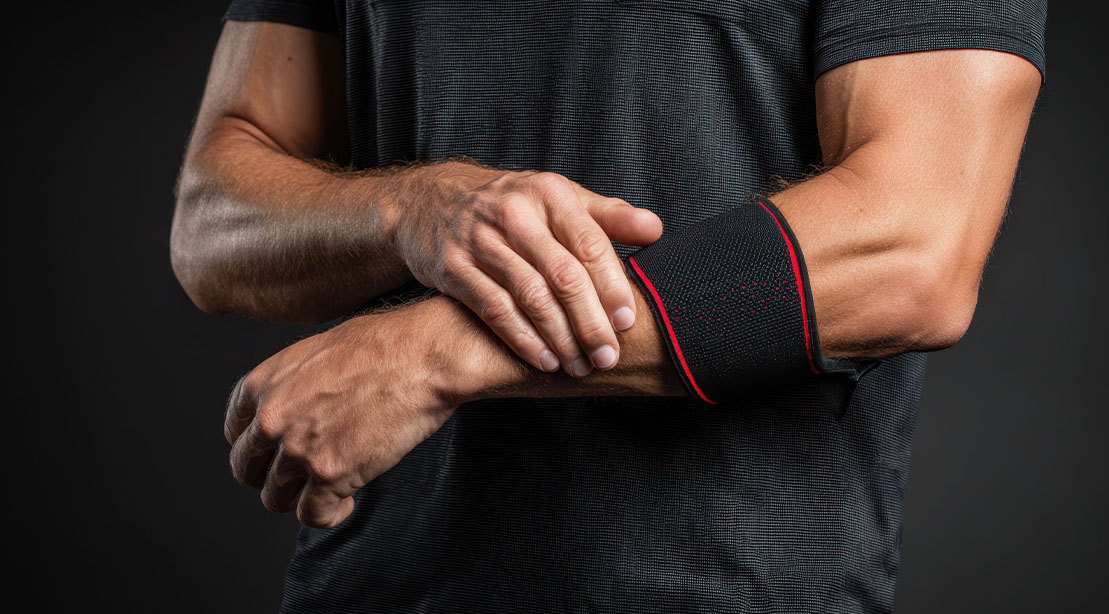
Walk into any serious gym and you’ll eventually see it: Some guy curling little pink dumbbells with his arms wrapped like he’s smuggling diamonds across a border. His face is red, veins are standing at attention, and the pain looks—disproportionate to the load.
That’s probably occlusion training—also known as blood flow restriction (BFR) or tourniquet training—and despite how absurd it can look, it’s one of the most effective hypertrophy tools most lifters either don’t know about, misunderstand or misuse entirely.
Like any training method, occlusion isn’t magic, it isn’t new, and it definitely isn’t idiot-proof. But used correctly, it can build muscle, spare joints, extend careers, and keep you growing long after heavy weights start fighting back.
Used incorrectly, it’s just another way to get hurt while convincing yourself you’ve discovered something revolutionary.
What Occlusion Training Actually Is
Occlusion training involves partially restricting venous blood flow out of a working muscle while still allowing arterial blood flow in. The key word here is “partially.” You’re not trying to shut the limb down like a battlefield medic. The intent is to create a bottleneck.
Blood gets in. Blood struggles to get out.
That controlled restriction creates a hypoxic, metabolite-rich environment inside the muscle—one that closely mimics the internal stress of heavy loading, even though the external load is laughably light.
This isn’t a new idea. Versions of BFR have been used for decades in rehabilitation settings, most notably in Japan, where it was originally developed to help injured athletes maintain muscle mass without stressing damaged joints or connective tissue. Even bodybuilders have tried blood flow restriction after recovering from injury with good results.
What is new is how widely it’s being used in mainstream bodybuilding and strength training—and how badly it’s being butchered on social media.
How It Works (And Why It Feels So Brutal)
Muscle growth is driven primarily by three mechanisms:
- Mechanical overload
- Metabolic stress
- Muscle damage
Traditional heavy lifting emphasizes mechanical load. Occlusion training leans hard into metabolic stress, and it does so efficiently and fast.
When venous blood flow is restricted, metabolites like lactate and hydrogen ions accumulate rapidly. Oxygen levels drop. The muscle swells as fluid builds up. The nervous system is forced to recruit higher-threshold motor units earlier than it normally would with such light loads.
In short, the muscle gets tricked into thinking it’s working far harder than it is.
That’s why 25% of your one-rep max can suddenly feel like a near-death experience by rep 20.
The “burn” isn’t incidental—it’s the point.
The Most Important Thing People Get Wrong
Occlusion training is not about pain tolerance.
It’s about fatigue and fiber recruitment.
There’s a difference.
If your hands go numb, your foot turns white, or you lose sensation entirely, you’re not training—you’re failing a basic anatomy quiz. More restriction does not equal more growth. It equals unnecessary risk. This is where internet bravado ruins a good method.

How to Do It Correctly
Placemen Note: arms and legs only. Placed anywhere else and you win a Darwin award.
- Arms: High on the upper arm, just below the deltoid
- Legs: High on the thigh, near the hip crease
Never place wraps near joints or mid-limb. The goal is to affect the entire muscle belly downstream.
Tightness
Think 7 out of 10.
You should still feel a pulse. Skin color should remain normal. No tingling, no numbness.
If you wouldn’t sit like that for five minutes without training, it’s too tight.
Load
This is where egos go to die.
- 20–30% of 1RM
- Yes, it’s light
- No, you’re not special
- Physics and physiology don’t care how long you’ve been lifting
Classic Set Protocol
- 1st set: 30 reps
- Sets 2–4: 15 reps
- Rest: ~30 seconds between sets
- Keep the wraps on for the entire sequence, then remove them.
That’s it. You’re done. More is not more.
Where Occlusion Training Excels
This is not a replacement for heavy training. It’s a supplement—and a valuable one.
Consider This Accessory Work For:
Arms, calves and hamstrings—small to mid-sized muscle groups respond exceptionally well—Quads not so much, but still effective if you can get the tourniquet high enough.
Joint Preservation
If your elbows bark every time you curl heavy, occlusion lets you stimulate growth without grinding cartilage into dust.
Rehab and De-loads
BFR allows injured or beat-up lifters to maintain—or even gain—muscle while connective tissue catches up.
Finishing Move
After your heavy compound work, occlusion sets can push additional hypertrophy without additional joint stress.
Where It Does NOT Belong
- Heavy compound lifts under full occlusion
- Marathon occlusion sessions lasting 20–30 minutes
- Wrapped like a hostage negotiation gone wrong
You don’t squat heavy with your femoral artery half-closed. You might think that’s hardcore—but it’s not. It’s just stupid.
Is It Safe?
For healthy individuals, performed correctly, occlusion training has an excellent safety record and is widely used in clinical rehabilitation environments.
That said, clear it with a medical professional if you have:
- Clotting disorders
- Vascular disease
- Uncontrolled hypertension
- Recent surgery
Occlusion is stress. Controlled stress—but still stress.
The Psychological Side Effect Nobody Talks About
Occlusion training teaches something valuable: Effort is not synonymous with load.
Many lifters equate progress with heavier weights forever, ignoring that joints, tendons, and connective tissue don’t adapt on the same timeline as muscle. BFR forces you to confront the idea that intelligent training sometimes looks unimpressive—but works anyway.
That lesson alone is worth the price of admission.
The Bottom Line
Occlusion training isn’t a gimmick.
It’s not a shortcut.
And it’s definitely not a license to wrap yourself like a mummy and chase pain.
Used correctly, it allows you to:
- Build muscle with minimal joint stress
- Extend training longevity
- Continue progressing when heavy loading isn’t practical
Used incorrectly, it’s just another way to get hurt while blaming the method instead of the execution.
This is not a method for beginners. Like any advanced technique, occlusion training rewards restraint, understanding, flawless execution and discipline—four qualities that don’t always trend well on social media, but have always built great physiques.
Light weights can hurt—and I’m not talking about your ego—sometimes, that’s exactly the point.